

The life we live is the life we learned to live.
A life shaped by what we are taught, what is expected of us, what is rewarded and what is frowned upon. We learn what it means to be good, successful, responsible, respectable. We learn what to pursue and what to avoid.
And somewhere along the way, we stop asking whether the life we are living is indeed the one we have consciously chosen.
After all, when life appears to be going well, why question it?
We have relationships, careers, families, responsibilities. We make plans, achieve milestones, and fulfil obligations. We do what needs to be done. And there is comfort in the familiar, and reassurance in knowing what comes next.
Yet, there are times when a life that appears good by conventional measures leaves us feeling deeply dissatisfied.
Is the life we have worked so hard to build also the life we have learned not to question?
The price of a good life
In my book First You Have To Say Goodbye: A Gentle Guide for the Unfolding Soul, I wrote:
Having a perceived ‘good life’ came at a price. It was silencing. When things did not go as planned, guilt and shame assailed me. And this motivated me to strive for betterment because that’s what I was conditioned to do.
The saying ‘ignorance is bliss’ is true in our human experience. The wilful or inadvertent denial of our painful existence allows us to function and persevere despite the wounds in our lives.
So we stay asleep. But we cannot avoid dreaming. And we cannot avoid the nightmares-each like the other, repeating in an endless loop until we choose to confront them or are forced to.
Beyond the dark night of sleep, we go through our day in a foggy state-doing what we ought to, meeting the expectations we have long been accustomed to. We no longer question the busyness of living a ‘normal life’. The damaging relationships and hurtful conversations no longer surprise us.
I wrote those words from a place of recognition. Of beginning to see what had long been present but remained largely unquestioned.
Looking back, I wonder how much of what I believed to be a good life was shaped by what I had learned a good life ought to look like.
And how much of my striving was driven not by desire or curiosity, but by a fear of falling short.
My cultural upbringing placed considerable value on striving. To work hard, to do better, to achieve more. Competition was a motivator, and success something to be pursued. Alongside these expectations were the moral boundaries of Christian teachings, the many thou-shall-nots that informed what was acceptable, what was right, and what it meant to be good.
There was much in these teachings that offered guidance, discipline and a sense of belonging. But there were also expectations that I came to accept without question.
To be good was to do what was right. To succeed was to keep striving. There is no option for “failure” - to fall short was to try harder.
And when things did not go as planned, guilt and shame followed.
I recognised then that the choices we make are not distinct from the cultural conditioning of families and societies.
We do not arrive in this world with an independent understanding of who we are or ought to be. We come to “know” ourselves through relationships, language, culture, beliefs and the experiences that shape us.
And so, what we believe to be our own choices are in fact deeply intertwined with the expectations we have inherited.
Those choices are not necessarily wrong, in fact judgment is not where we begin. We begin by acknowledging that the choices we make are worthy of questioning.
The familiar is not necessarily the good
I have come to appreciate how easily we confuse familiarity with what is good for us.
We become accustomed to certain ways of relating, speaking, thinking and being. We learn what is acceptable or valued, what is supposedly safe, what keeps the peace.
And we adapt.
We may silence ourselves to preserve a relationship. We may tolerate what hurts because we have learned that this is what purportedly love, loyalty or commitment requires. We may continue along a path long after it has ceased to be meaningful, because changing direction feels like failure.
Sometimes, we are not conscious of making these choices. They have just become our way of being in the world.
I don’t mean to call this living inauthentically. It seems too easy, and perhaps unfair, to judge our earlier selves with the understanding we have today.
We were making sense of our world with what we knew and what was available to us. And perhaps they served us well.
So what makes it possible for us to see differently? What might we do with this new awareness?
When something no longer fits
I believe change begins long before we recognise it. Change occurs every moment, whether we recognize it or not - in the quiet discomfort that accompanies an otherwise ordinary day, in the weariness that rest does not seem to resolve, in a conversation that leaves us feeling strangely diminished, in the recurring thought that there must be something more to life, though we cannot yet name what that is.
Sometimes it is a significant event that unsettles us - a loss, a separation, an illness, a disappointment - which interrupts the rhythm of the life we know.
We begin by noticing.
Something no longer sits comfortably. Something begins to lose its hold. Something becomes a question.
For me, one such something was about striving.
I had long understood striving as something admirable. And it can be. There is much to value in endeavour, perseverance, discipline and the desire to grow.
But I began to question whether striving ought to be the organising principle of life.
While striving can be a noble endeavour, it need not be the sole purpose of life. It should not be.
Within everyday living, there is an ebb and flow. Of activity and consolidation, progress and pause, building and dismantling.
There are times to pursue and to remain still. Times to hold on and to let go. Times to make something of our lives and also to enjoy the fruits of our labour.
Not everything needs to lead somewhere. Not every experience needs to be productive. Not every pause is a setback. Not everything we have built needs to be preserved.
How much of life do we miss when we are continually looking towards what comes next?
How much of ourselves do we overlook in the process?
The chasm between knowing and doing
Yet, recognising something does not necessarily mean we are able to change it.
Why do we, even when we know something is hurting us, continue to participate in it?
Why do we return to relationships that diminish us, repeat behaviours that leave us dissatisfied, or continue to pursue things that no longer hold meaning?
Why is knowing sometimes not enough?
There is a chasm between knowing and doing. A deeply human space that we may find ourselves inhabiting, sometimes for years.
Its width and depth dependent in part, by our self-awareness, our courage to recognise and acknowledge what is happening, and our willingness to embrace change.
Also, there are histories, relationships, responsibilities and fears that cannot simply be reasoned away. There are consequences to making different choices, not only for ourselves but also for those whose lives are intertwined with ours.
Sometimes we know what we need, but cannot yet bear what it might cost.
Sometimes we recognise what is hurting us, but have not found a way to live differently.
And it is tempting to judge ourselves in this space.
Why am I still doing this? Why can’t I just move on? Why do I keep making the same mistakes?
Perhaps this is where compassion is most needed.
This is the compassion that allows us to approach our own humanity with curiosity rather than condemnation, to recognise that change is rarely a straightforward or direct movement from awareness to action.
And this self-compassion may also be what allows us to remain with the discomfort long enough before the impetus to take action.
A life we are willing to question
We live in a world that is quick to offer solutions. We feel compelled to resolve rather than to sit with any discomfort.
When we feel lost, we are encouraged to find our purpose. When we feel stuck, we are told to make a change. When we experience discomfort, we are urged to overcome it, reframe it, or turn it into an opportunity for growth.
But self-awareness is not another thing to achieve.
Can we simply become more curious about who we are, how we came to be, and what else might be possible?
Awareness does not erase our histories. Nor does it free us from the complexity of being human.
Rather it offers a little space. To notice before we react, to consider a different response, to recognise that what we have always done need not be what we must continue to do.
And perhaps, with time, we become less afraid of the unfamiliar.
I return to those words from my book, particularly the image of moving through our days in a foggy state.
I wonder how often we mistake movement for progress, busyness for purpose, and endurance for strength.
How often do we continue doing what we have always done, not because it nourishes us, but because we have ceased to notice, to be curious, to question?
Are we present to the lives we are living?
Can we recognise what sustains us and what diminishes us? Hold gratitude for what has been, without feeling obliged to remain who we once were? Allow ourselves to change, even when that change is uncomfortable, uncertain, or difficult for others to understand?
I do not think we ever fully wake up, once and for all, to a thing.
Being awake is a way of being attentive to ourselves and the world around us, of noticing, questioning and remaining open to what we have yet to understand.
What have you come to accept as normal in your life, not because it is good for you, but because it has always been so?
In the messiness of life, we keep becoming.
Florence
On Meaning and Becoming
About Florence · Explore working with me · Discover my book
Did someone come to mind as you read this? Share it with them—perhaps it will open a conversation worth having.
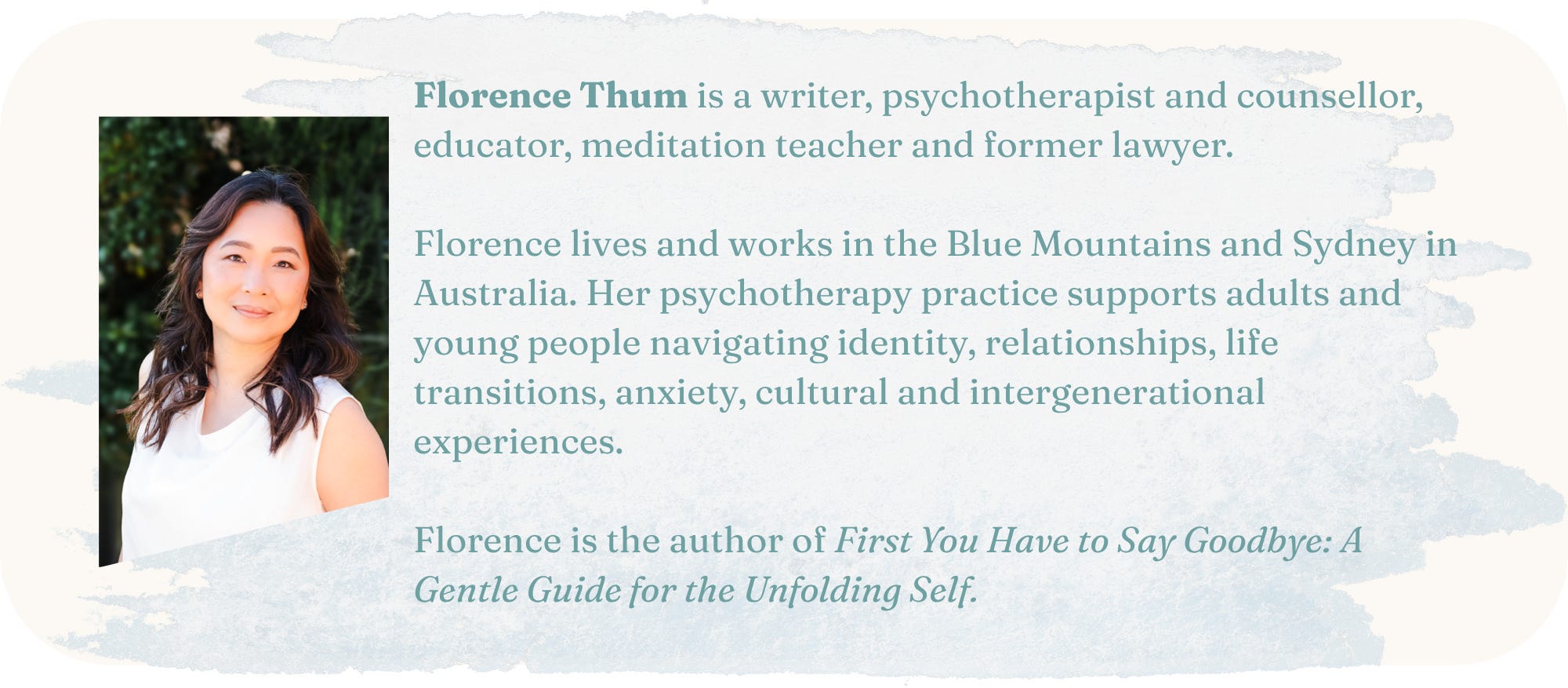
Florence’s psychotherapy practice supports adults and young people navigating identity, relationships, life transitions, anxiety, cultural and intergenerational experiences.
If you’d like space to explore what’s changing, what feels tangled, or what matters to you now, get in touch for a complimentary 15-minute conversation about working together in psychotherapy and counselling.
Also, if you have other queries, contact Florence