

Psychotherapy is sometimes described as time spent “just talking”.
Why dwell on our problems? Why revisit what happened? Why not move on?
I understand these questions. When we are hurting, we look for relief. Speaking about our pain may be the last thing on our minds; we just want to leave it behind.
Yet moving on is not always a matter of decision. Familiar ways of protecting ourselves can follow us into our next relationship.
Psychotherapy offers a space to explore these patterns: our thoughts, habits, ways of feeling, behaving and relating. What happens when someone disagrees with us? What do we do with disappointment? What must we conceal to remain loved?
A therapist accompanies this exploration. I am a witness who brings another perspective, who notices, wonders and sometimes gently challenges. How have our patterns served us? What might they now be costing us?
Carl Rogers, whose work shaped person-centred therapy, placed empathy, genuineness and unconditional positive regard at the heart of the therapeutic relationship. There is something deeply humane here: being met with care while coming to know parts of ourselves we struggle to accept.
Within this client-therapist relationship, we may begin to look closely. And looking closely can be uncomfortable. We have our blind spots.
We have learnt to protect ourselves and make difficult circumstances bearable. Silence may have helped us avoid conflict. Being agreeable may have preserved a relationship. Keeping busy may have kept sorrow at a manageable distance.
Approaching ourselves with honesty and compassion is no easy feat. And there is another difficulty.
So much of “talk therapy” depends on words.
What if words do not come easily? What if we can describe everything that happened yet struggle to say how it felt? What if we do not know?
We may sense only a heaviness, a restlessness, a tightening.
Or we may have plenty of words. Fluent, thoughtful, convincing words. We can explain ourselves beautifully while remaining distant from what we feel.
Words can bring us closer to ourselves, and they can also help us stay safely away.
Which brings me to poetry.
The language of poetry is often the language of the heart. I am thinking beyond formal verse, rhyme or poems we were taught to decipher at school. Away from the demand of finding the correct interpretation, we allow ourselves to imagine, feel and wonder.
Poetry often makes us pause, or creates an image that lingers. Sometimes, it presents a line we return to, or avoid.
Poetry gives space for experiences that resist tidy explanations. Loving someone yet feeling relieved when they leave, grieving a life we chose to leave behind, being grateful and deeply dissatisfied.
A poem can hold these experiences together without requiring immediate resolution. Life is full of uncertainties and contradictions after all.
Sometimes a line gives voice to something we have long felt but could not express. Sometimes it opens an unfamiliar possibility.
And sometimes we recoil. A line jars; a poem leaves us cold.
Perhaps ambiguity unsettles us. Perhaps the language feels inaccessible, or the perspective alien.
What catches our attention? What feels familiar? Do we want to turn away? Does it speak to or confront us?
Even disagreement may reveal something. Discovering what does not fit can bring us closer to what does.
Every reaction is worth exploring. Whether we do so remains a matter of choice.
Consider the difference between declaring, “I struggle to express my needs,” and poetically saying, “I make myself small so there is room for everyone else.”
The first identifies a difficulty, but it is the second which gives it an image and allows the space for curiosity and exploration.
What does small feel like? When did making ourselves small become familiar? What might taking up more room mean?
A metaphor gives us somewhere to begin.
This reminds me of Eugene Gendlin’s Focusing, where we attend to a bodily felt sense: an initially unclear sense of a whole situation, from which words or images may emerge. We pause to notice whether they fit that bodily experience.
We try a word. We listen and notice our response to it.
Sad may fit, but lonely makes the sadness more particular. Then an image: peering into a house where everyone else seems to belong.
What draws our attention? Do we want to enter? What happens within us as we stay with the image?
The image belongs to the person experiencing it. Its meaning is theirs to discover, and may change as we attend to it.
Such exploration may also unsettle the stories we tell about ourselves.
“I have nothing to offer” may sit alongside a forgotten moment of generosity. “I do not need anyone” may coexist with a longing for company.
A poem may remind us of a dismissed desire, a concealed tenderness, a possibility we stopped considering, the times we resisted, the care we offered.
Words become a space to remember what was lost or denied, and to consider how we wish to live.
A memory, silence or change of subject can become grist for the mill: ordinary experience explored together. A poem offers another way into that conversation - while it cannot change our past, it can change how we hold it.
Some circumstances remain beyond our control. Yet understanding may open present possibilities in how we relate to our experience and respond.
T. S. Eliot writes:
We shall not cease from exploration
And the end of all our exploring
Will be to arrive where we started
And know the place for the first time
~ “Little Gidding”, Four Quartets
I think of familiar places within us, seen differently when we return with understanding and company.
Has a poem ever found words for something you could not express? What did it help you recognise?
In the messiness of life, we keep becoming.
Florence
On Meaning and Becoming
About Florence · Explore working with me · Discover my book
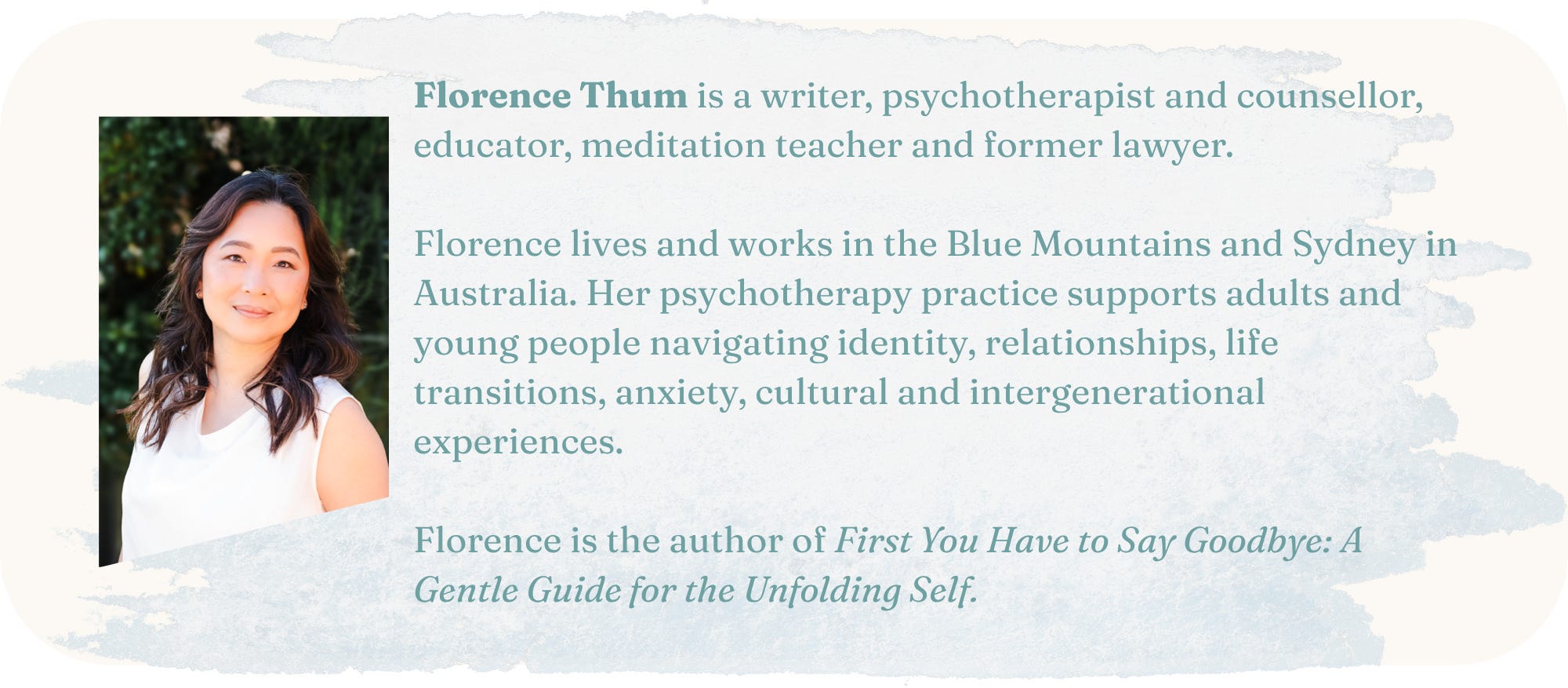
There’s more to explore beyond this essay. If you’re finding your way through endings, change or new beginnings, my book, First You Have to Say Goodbye: A Gentle Guide for the Unfolding Self, might be good company. Pick up a copy on Amazon.
Contact Florence to explore working together through life transitions, relationships, identity, belonging, grief and loss.